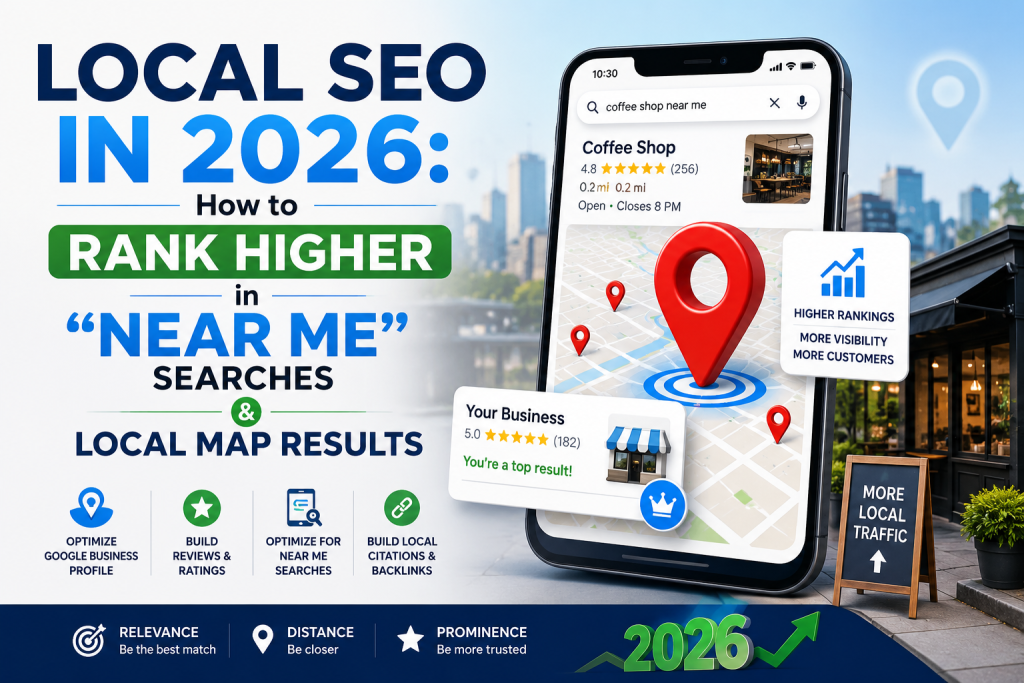
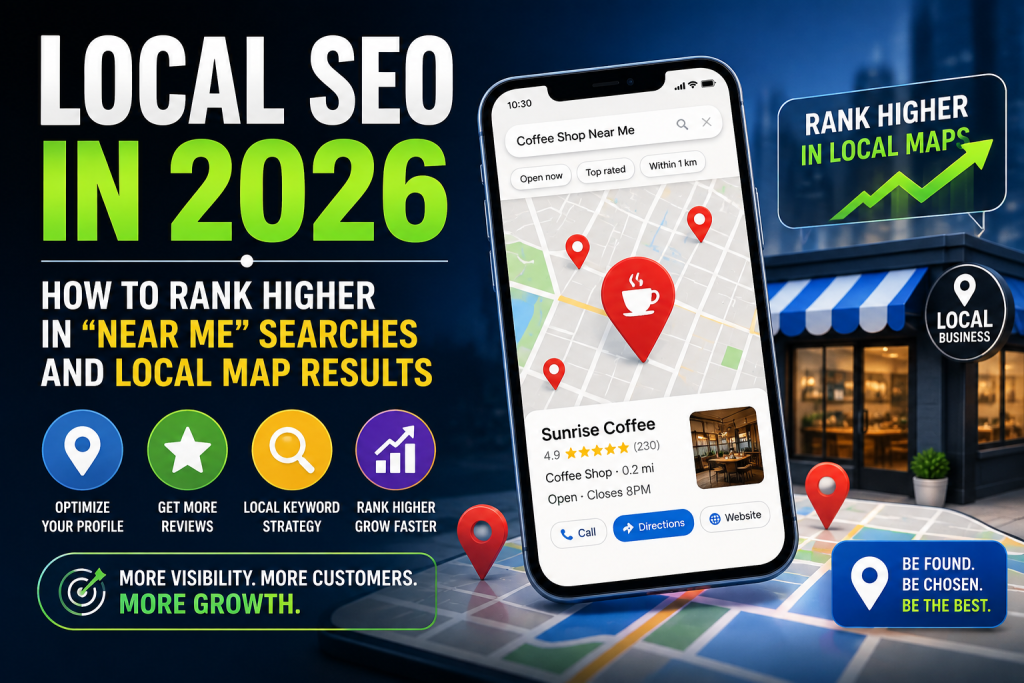
For businesses that serve customers in a specific geographic area, local SEO can be more valuable than broad national SEO efforts. For example, restaurants, dentists, law firms, home service providers, and retail stores can benefit greatly from targeting local searches.
When people search for terms such as “plumber near me” or “best coffee shop in downtown,” they are usually looking for relevant businesses nearby. Therefore, appearing prominently in these local search results can help businesses reach customers who are actively looking for their products or services.
Moreover, a strong local SEO strategy can increase online visibility, attract more potential customers, and build a stronger presence within the target area. As a result, businesses can connect with local customers more effectively and generate more opportunities for growth.
In addition, optimizing for local search helps businesses compete with other companies in the same area. By improving their local search presence, businesses can make it easier for potential customers to find, evaluate, and choose their services.
What Is Local SEO?
Local SEO is the process of optimizing your online presence to attract more customers from relevant local searches. Unlike traditional SEO, which aims to compete for visibility on a national or global scale, local SEO focuses on reaching customers in a specific city, region, or service area.
In particular, local SEO helps businesses improve their visibility in Google’s Local Pack, which is the map and three-listing section that often appears for local search queries. In addition, local SEO can help businesses appear in standard organic search results.
Therefore, a strong local SEO strategy can make it easier for nearby customers to discover your business. Moreover, it can help you reach people who are actively searching for the products or services you offer.
Generally, local search rankings are influenced by three core factors. According to most industry ranking studies, these factors include:
- Relevance — how well your business matches what the searcher is looking for
- Distance — how close your business is to the searcher’s location
- Prominence — how well-known and reputable your business is, both online and offline
Google Business Profile: The Foundation of Local SEO
Your Google Business Profile (GBP) , formerly known as Google My Business, is the single most important asset in local SEO. It’s the listing that appears in Google Maps and the Local Pack.
Local SEO – Setting Up and Optimizing Your Profile
To maximize your GBP’s effectiveness:
- Claim and verify your listing through Google’s verification process (postcard, phone, or email, depending on business type)
- Choose accurate categories — select a primary category that precisely matches your core business, plus relevant secondary categories
- Complete every field — hours of operation, phone number, website, service areas, and attributes (e.g., “wheelchair accessible,” “outdoor seating”)
- Write a keyword-rich business description that naturally incorporates terms customers search for, without keyword stuffing
Photos and Visual Content
Listings with high-quality, regularly updated photos tend to receive significantly more engagement than those without. Include:
- Exterior and interior shots
- Team photos
- Product or service photos
- Photos that update seasonally or reflect current offerings
Google Posts
Google allows businesses to publish short updates, offers, and events directly on their profile. Regularly posting signals an active, well-maintained business and gives you another opportunity to appear in relevant searches.
Q&A Section
The Questions & Answers feature lets potential customers ask questions publicly. Proactively seeding common questions (and answering them yourself) helps control the narrative and provides useful information before a customer even contacts you.
NAP Consistency: Name, Address, Phone Number
One of the most overlooked but critical local SEO factors is NAP consistency ensuring your business Name, Address, and Phone number are identical across every platform where your business appears: your website, GBP, social media, and third-party directories.
Inconsistent NAP data (e.g., “St.” vs. “Street,” or an outdated phone number on one directory) confuses search engines about which information is accurate, which can dilute your local ranking signals and erode customer trust.
Local Citations
A citation is any online mention of your business’s name, address, and phone number, typically on directory websites. Citations reinforce your business’s legitimacy and location to search engines.
Key Citation Sources
- Major data aggregators that distribute business data across the web
- General directories such as Yelp, Bing Places, Apple Maps, and Facebook
- Industry-specific directories — for example, Avvo for lawyers, Healthgrades for medical providers, or TripAdvisor for hospitality businesses
- Local directories — chamber of commerce listings, local news sites, or community business associations
Building and Managing Citations
- Audit existing citations for accuracy and consistency
- Prioritize quality, relevant directories over mass-submitting to low-value sites
- Regularly monitor for outdated information, especially after a business move, rebrand, or phone number change
On-Page Local SEO
Your website itself needs to be optimized for local relevance, not just your Google Business Profile.
Location Pages
Businesses with multiple locations should create a dedicated, unique page for each location, including:
- Location-specific NAP information
- Embedded Google Map
- Localized content (not duplicated across every location page)
- Location-specific customer reviews or testimonials where possible
Localized Content and Keywords
Incorporate geographic modifiers naturally into titles, headers, and body content for example, “emergency plumbing services in [City]” rather than a generic, location-agnostic phrase. Avoid keyword stuffing; the goal is natural, useful content that happens to include local context.
Local Schema Markup
Implementing LocalBusiness schema markup helps search engines understand key details about your business address, hours, price range, and service area increasing the likelihood of enhanced local search results.
Mobile Optimization
A large share of local searches happen on mobile devices, often with immediate intent (“call now,” “get directions”). Ensure your site loads quickly and that contact information and calls-to-action are easy to tap.
Online Reviews and Reputation Management
Reviews are one of the strongest local ranking and conversion factors. Prospective customers use them to build trust, and search engines use review signals (volume, recency, and rating) as a prominence factor.
Strategies for Generating Reviews
- Ask satisfied customers directly, ideally right after a positive interaction
- Send automated follow-up requests via email or SMS after a purchase or service
- Make the review process as frictionless as possible with direct links to your GBP review page
Responding to Reviews
Responding to both positive and negative reviews demonstrates active management and customer care:
- Thank customers for positive reviews, personalizing responses when possible
- Address negative reviews professionally and constructively, offering to resolve issues offline when appropriate
- Never use fake reviews or incentivized reviews that violate platform policies this can lead to listing suspension
Local Link Building
Earning backlinks from locally relevant, authoritative sources strengthens your local prominence:
- Partner with local businesses for cross-promotion or co-marketing
- Sponsor local events, charities, or sports teams (which often include a website link)
- Get featured in local news coverage or community blogs
- Join local business associations that link to member websites
Voice Search and Local SEO
With the growing use of voice assistants, many local searches now happen conversationally “where’s the nearest pharmacy that’s open now.” Optimizing for voice search overlaps significantly with strong local SEO fundamentals:
- Maintain accurate, structured business information (hours, address, services)
- Use natural, question-based content (FAQ sections work well)
- Ensure fast mobile page speed, since voice queries are predominantly mobile-driven
Tracking Local SEO Performance
Key metrics to monitor include:
- Local Pack rankings for target keywords and locations
- Google Business Profile insights — views, calls, direction requests, and website clicks https://business.google.com/en-all/business-profile/
- Review volume and average rating over time
- Website traffic from local/organic search, segmented by location if you serve multiple areas
Tools like Google Search Console, Google Business Profile Insights, and dedicated local rank trackers can help monitor progress and identify areas needing improvement.
Local SEO rewards consistency, accuracy, and genuine community presence more than aggressive optimization tactics. A well-optimized Google Business Profile, consistent NAP data, quality local citations, positive reviews, and locally relevant content form the foundation of a strong local search presence. For businesses that depend on nearby customers, investing in local SEO isn’t optional — it’s often the most direct path to new business.