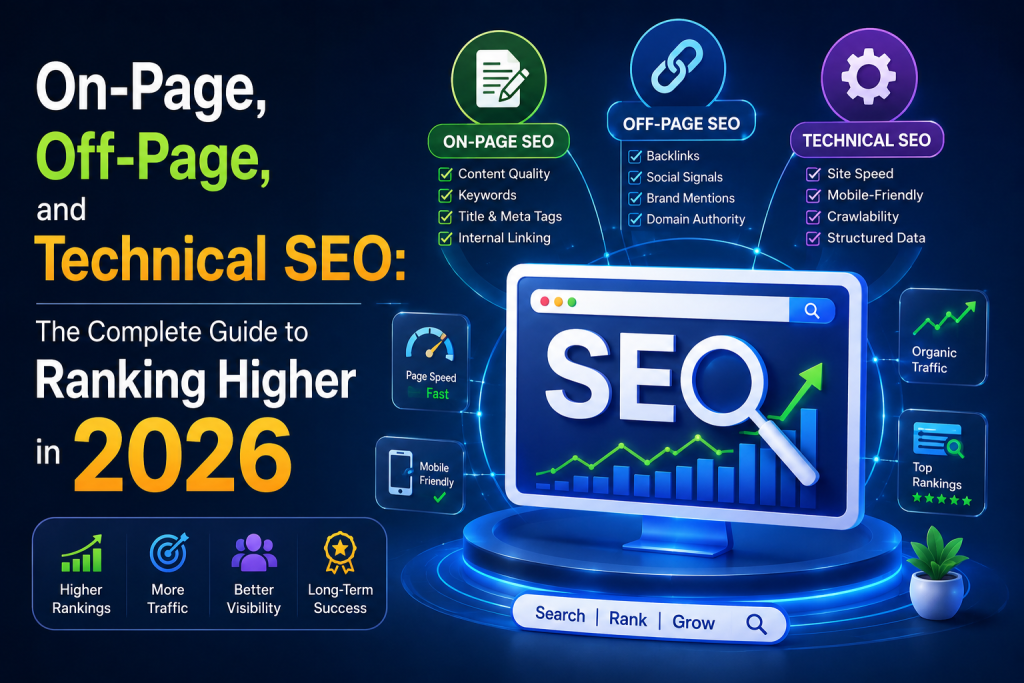
Search engine optimization is often talked about as one single discipline, but in reality it is built on three distinct pillars: on-page SEO, off-page SEO, and technical SEO. Each plays a different role in how search engines discover, understand, and rank your website. Ignoring any one of them creates a weak link that can hold back your entire strategy , no matter how good your content or backlinks are.
This guide breaks down each pillar, explains why it matters, and gives you a practical framework you can apply to your own website.
Why On Page Off-Page, and Technical SEO Still Matters in 2026
With AI-generated answers and dynamic search engine result pages (SERPs), some marketers believe traditional SEO is losing its value. However, the opposite is true. SEO remains essential for improving online visibility, reaching the right audience, and driving organic traffic.
Today, search engines and AI-powered answer engines still depend on key On Page Off-Page, and Technical SEO signals. These include relevance, authority, and technical accessibility. Therefore, businesses must optimize their websites across all three areas to achieve better search rankings and stronger online visibility.
First, relevant content helps search engines understand what your website offers. Next, authority shows that your content is trustworthy and valuable. Finally, technical SEO makes it easier for search engines and AI systems to crawl, understand, and index your pages.
As a result, a well-optimized website has a better chance of appearing in search results and AI-generated answers. More importantly, effective SEO can help you attract qualified visitors, increase website traffic, generate leads, and grow your business.
So, instead of moving away from traditional SEO, marketers should strengthen their SEO strategy. By combining high-quality content, strong authority, and solid technical performance, you can improve your visibility across both traditional search engines and modern AI-powered search experiences.
Let’s break down each pillar in detail.
Pillar 1: On Page SEO: Key Strategies and Best Practices
On-page SEO refers to everything you control directly on your website’s pages content, structure, and HTML elements to help search engines understand what a page is about and match it to relevant search queries
SEO – Keyword Research and Search Intent
Before writing a single word of content, you need to understand what your audience is actually searching for. This means going beyond keyword volume and identifying search intent , whether someone wants information, is comparing options, or is ready to buy.
There are four common intent types:
- Informational — “what is technical SEO”
- Navigational — “Google Search Console login”
- Commercial investigation — “best SEO tools 2026”
- Transactional — “hire SEO agency”
Matching your content format to intent is critical. A transactional query deserves a landing page, not a 3,000-word blog post.
Title Tags and Meta Descriptions
Your title tag is one of the strongest on-page ranking signals and the first thing users see in search results. Best practices include:
- Keep titles under 60 characters
- Place your primary keyword near the beginning
- Make it compelling enough to earn a click, not just accurate
Header Structure (H1–H6)
A clear heading hierarchy makes your content easier to read, understand, and navigate. First, use one H1 heading for the main topic of your page. Then, organize your content with relevant H2 and H3 headings.
This structure helps users quickly find the information they need. At the same time, it helps search engines understand the topic and structure of your content. As a result, your pages can become easier to crawl, index, and rank.
Moreover, a well-organized heading structure can improve your visibility in modern search experiences. AI search tools can use clear headings to identify key information and summarize your content for featured snippets and AI-generated overviews.
Therefore, optimize your headings with relevant keywords and clear descriptions. By using a logical heading structure, you can improve readability, strengthen SEO, increase visibility, and help users find valuable information faster.
Content Quality and Depth
Google’s guidelines emphasize E-E-A-T — Experience, Expertise, Authoritativeness, and Trustworthiness. Content that demonstrates real expertise, cites credible sources, and thoroughly answers the user’s question tends to outperform thin or generic content.
Practical tips:
- Answer the core question within the first 100 words
- Use original data, examples, or case studies where possible
- Update content regularly to keep it accurate and relevant
Internal Linking
Internal links help distribute “link equity” across your site and guide both users and crawlers to related, important pages. A strong internal linking structure typically follows a pillar-and-cluster model, where a comprehensive pillar page links out to detailed cluster articles on subtopics.
Image Optimization
Images should include descriptive file names and alt text, both for accessibility and to give search engines additional context. Compressing images also improves speed , a factor that bridges on-page and technical SEO.
URL Structure
Clean, descriptive URLs (e.g.:https://eminds.com.au/our-practical-digital-marketing-courses/.) are easier for users to understand and for search engines to categorize.
Pillar 2:Off-Page SEO: Key Strategies and Best Practices
Off-page SEO covers actions taken outside your own website that influence your rankings and reputation. It’s primarily about building authority and trust in the eyes of search engines.
SEO – Off-Page – Backlinks
Backlinks remain one of the most influential ranking factors. A backlink acts as a vote of confidence from one site to another. However, not all backlinks are equal quality outweighs quantity.
High-value backlinks typically come from:
- Industry-relevant, authoritative websites
- Sites with genuine organic traffic (not link farms)
- Naturally earned placements (through outreach, PR, or valuable content) rather than purchased links
Link Building Strategies
Effective, sustainable link building tactics include:
- Guest posting on reputable industry blogs
- Digital PR — creating newsworthy content (original research, surveys) that journalists want to reference
- Broken link building — finding dead links on relevant sites and suggesting your content as a replacement
- Resource page outreach — getting listed on curated resource pages in your niche
Avoid manipulative tactics like link schemes or paid link networks, which violate search engine guidelines and can result in penalties.
Brand Mentions and Digital PR
Even unlinked brand mentions across the web can contribute to authority signals. Building genuine media coverage, being quoted as an expert source, and appearing in industry roundups all strengthen your brand’s footprint.
Social Signals
While social shares aren’t a direct ranking factor, an active social presence increases content visibility, which can lead to more organic backlinks and traffic an indirect but meaningful contribution to off-page SEO
Online Reviews and Reputation
For many businesses, especially those with a local or service component, reviews on platforms like Google, Trustpilot, or industry-specific directories affect both trust signals and conversion rates.
Pillar 3: Technical SEO: Key Strategies and Best Practices
Technical SEO ensures that search engines can efficiently crawl, index, and render your website. Even the best content will underperform if technical barriers prevent search engines from accessing it properly.
Site Speed and Core Web Vitals
Page experience metrics Largest Contentful Paint (LCP), Interaction to Next Paint (INP), and Cumulative Layout Shift (CLS) directly impact both rankings and user experience. Common fixes include:
- Compressing and lazy-loading images
- Minimizing JavaScript and CSS render-blocking resources
- Using a content delivery network (CDN)
- Enabling browser caching
Mobile-Friendliness
With mobile-first indexing, Google primarily uses the mobile version of your site for ranking and indexing. Responsive design, readable font sizes, and tap-friendly navigation are essential baseline requirements.
Crawlability and Indexability
Search engines need clear pathways to discover your content
- Maintain a clean, updated XML sitemap
- Use robots.txt correctly to guide (not accidentally block) crawlers
- Avoid orphan pages with no internal links pointing to them
- Fix crawl errors reported in Google Search Console
Site Architecture
A logical, shallow site structure (ideally no more than 3–4 clicks from the homepage to any page) helps both users and crawlers navigate efficiently.
Structured Data (Schema Markup)
Schema markup helps search engines understand context — such as marking up a page as a recipe, product, article, or FAQ. This increases eligibility for rich results (star ratings, FAQ dropdowns, product pricing) in search results, improving visibility and CTR.
HTTPS and Security
A secure site (HTTPS) is a baseline trust and ranking factor. Beyond SSL certificates, technical SEO also involves monitoring for malware, broken security certificates, and mixed content warnings.
Duplicate Content and Canonicalization
Duplicate or near-duplicate content confuses search engines about which version to rank. Canonical tags (rel=”canonical”) tell search engines which version of a page is the “master” copy, consolidating ranking signals
Crawl Budget Optimization
For larger sites, ensuring search engines spend their limited “crawl budget” on your most valuable pages rather than thin, duplicate, or low-value pages becomes an important technical consideration.
Bringing the On page , Off page and Technical SEO Together
None of these pillars work well in isolation:
- Great content (on-page) won’t rank if search engines can’t crawl the page (technical) or if no one trusts or links to the domain (off-page).
- A technically flawless site with no valuable content or external authority will struggle to compete for meaningful keywords.
- Strong backlinks (off-page) pointing to a slow, poorly structured page (technical) waste much of their potential value.
A sustainable SEO strategy treats these three pillars as interconnected systems, not separate checklists. Regular technical audits, ongoing content improvement, and consistent authority-building work together to compound results over time.
Final Thoughts: On Page Off-Page, and Technical SEO
SEO in 2026 is more competitive and technical than ever. However, the core SEO principles remain the same. To achieve better rankings, businesses should create genuinely valuable content, maintain a fast and technically sound website, and build credible authority across the web.
First, focus on high-quality content that answers your audience’s questions and provides real value. Next, improve your website’s speed, mobile performance, and technical SEO. In addition, earn trusted backlinks and strengthen your online authority through reliable websites and relevant industry sources.
As a result, your website can attract more qualified traffic and improve its search visibility. Rather than chasing quick SEO wins, invest in all three pillars for sustainable results. By combining valuable content, strong technical performance, and credible authority, businesses can build long-term organic visibility, increase traffic, generate more leads, and support steady business growth.