
Search has changed more in the last two years than in the previous decade. If you’re exploring the best SEO practices for AI SEO, you’re already ahead of the curve — AI Overviews, ChatGPT, Perplexity, and Google’s AI Mode now sit between your content and your audience. These tools answer questions directly instead of simply linking to websites.
Traditional rankings still matter. However, a new layer of visibility has emerged. Getting your content cited in AI-generated answers has become just as important.
The good news is that AI hasn’t replaced SEO fundamentals. It has expanded them. In 2026, the best-performing sites combine strong technical SEO with useful, trustworthy content. They also create content that AI systems can easily understand and quote.
Below are the 10 SEO practices worth prioritizing this year.
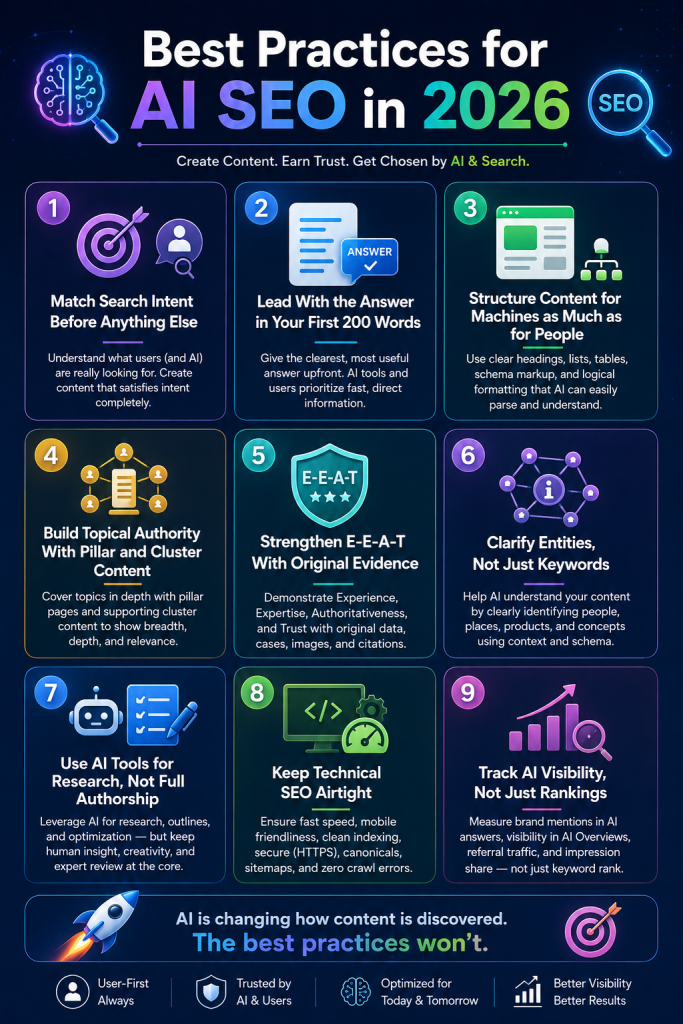
Match Search Intent Before Anything Else Best SEO Practices for AI SEO
Keyword matching alone no longer wins. Google and AI answer engines now evaluate whether a page satisfies the searcher’s intent. That intent may be informational, comparison-based, transactional, or navigational.
Before writing, identify what the searcher really needs. Then structure your page around that goal. Give them the most useful answer first.
Build the rest of your SEO strategy around search intent. This includes keywords, structure, formatting, and content depth.
Lead With the Answer in Your First 200 Words: Best SEO Practices for AI SEO
AI systems often give more weight to a page’s opening section when deciding whether to cite it. Treat your first two paragraphs as a short summary of the entire article.
State the core answer first. Highlight the key data point. Then present your main recommendation. Give readers and AI crawlers the essential takeaway before they scroll further.
Avoid hiding the answer under a long introduction. Both readers and AI systems may skip content that takes too long to reach the main point.
Structure Content for Machines as Much as for People: Best SEO Practices for AI SEO
Clear structure now acts as a ranking and citation signal, not just a readability feature. Use one focused H1 for the main topic. Add logical H2 and H3 subheadings for key subtopics.
Use bullet points and numbered lists to break up dense information. Research shows that AI systems consider three important layers when selecting citation sources.
These include document architecture, information structure, and visual emphasis. Use bold text and lists to highlight important facts. Easy-to-scan content also helps AI systems extract and quote information accurately.
Build Topical Authority With Pillar and Cluster Content
Ranking for a single keyword is far less valuable than owning an entire topic. Choose a core theme that relates to your business. Then, build an in-depth pillar page around that theme.
Support the pillar with closely related cluster articles. Link these articles back to the main pillar page. This structure signals topical depth to search engines.
It also gives AI systems more content to use when answering questions about your subject. Use strategic internal links to connect the cluster. This approach helps distribute authority across related pages.
Strengthen E-E-A-T With Original Evidence
Google’s guidance remains consistent. Create content that demonstrates real experience, expertise, authoritativeness, and trustworthiness. Generative search systems follow the same standard.
Generic, templated content is easy to spot and skip. This applies to both human readers and AI systems.
Use original research, first-hand case studies, proprietary data, and clearly credentialed authorship. These elements give your content unique value that AI-generated summaries cannot easily replicate. As a result, search engines and AI systems have more reasons to cite your content.
Clarify Entities, Not Just Keywords
Modern search engines increasingly understand content through entities. These include people, brands, products, and concepts. They also analyze how these entities relate to each other.
Google and AI systems use these connections to understand your brand and its topics. When they clearly associate your brand with a subject, you may appear for related queries you never directly targeted.
Use consistent naming across your website. Add structured data where relevant. Keep clear “About” and author information on your pages. These signals help reinforce your entity connections.
Use AI Tools for Research, Not Full Authorship
AI writing tools can help with outlines, keyword clustering, content briefs, and long-tail, question-based queries for voice and AI search. However, they often fall short when it comes to originality and lived expertise. The most effective approach combines AI-assisted drafting with real human review, insight, and editing before you publish anything. Google and AI platforms increasingly filter out content that feels scaled, unoriginal, or purely AI-generated without meaningful human input. Add genuine expertise and original insights to make your content more useful, trustworthy, and durable.
Keep Technical SEO Airtight: Best SEO Practices for AI SEO
None of the above matters if AI crawlers and search bots cannot access or parse your site efficiently. Fast load times and strong Core Web Vitals provide a solid technical foundation.
Focus on clean mobile usability and proper indexing. Keep your robots.txt file accurate and well maintained.
AI-driven crawlers may behave differently from traditional bots. However, they still rely on the same technical basics. Build a fast, accessible, and well-structured website that crawlers can navigate easily.
A strong technical foundation helps your content reach both search engines and AI platforms. and AI platforms.
Optimize for Long-Tail, Conversational Queries
People increasingly use full questions when searching through AI assistants. For example, they may ask, “What’s the best way to choose an SEO agency in 2026?”
Build content around natural-language and question-based queries. Include FAQs and direct Q&A sections where they add value. This approach aligns your pages with how AI systems retrieve and synthesize information.
Question-based queries can also face less competition than broad head terms. They may also attract users with stronger intent, which can improve conversions.
Track AI Visibility, Not Just Rankings
Traffic and ranking position no longer tell the whole story. Monitor how AI platforms such as ChatGPT, Perplexity, and Google’s AI Mode present your brand.
Run a set of representative prompts regularly. Record whether each platform mentions your brand and describes it accurately. Note which competitors appear instead.
Pair these checks with segmented analytics by topic cluster. Avoid relying only on site-wide totals. This approach shows which topics build authority and which areas need more work.
Treat AI-driven visibility as an important KPI alongside clicks. Track impressions, citations, and brand mentions to measure your visibility across these platforms.
Final Thoughts
AI hasn’t made SEO obsolete. It has made SEO broader, more cross-functional, and more demanding.
The brands that thrive in 2026 will treat AI Overviews and answer engines as new distribution channels. These platforms create new opportunities to earn visibility.
Start with the fundamentals: search intent, structure, authority, and technical health. Then add AI-specific tactics such as entity clarity and answer-first formatting.
Track citations to understand your visibility. This combination can turn AI visibility into real traffic and revenue.