
Introduction
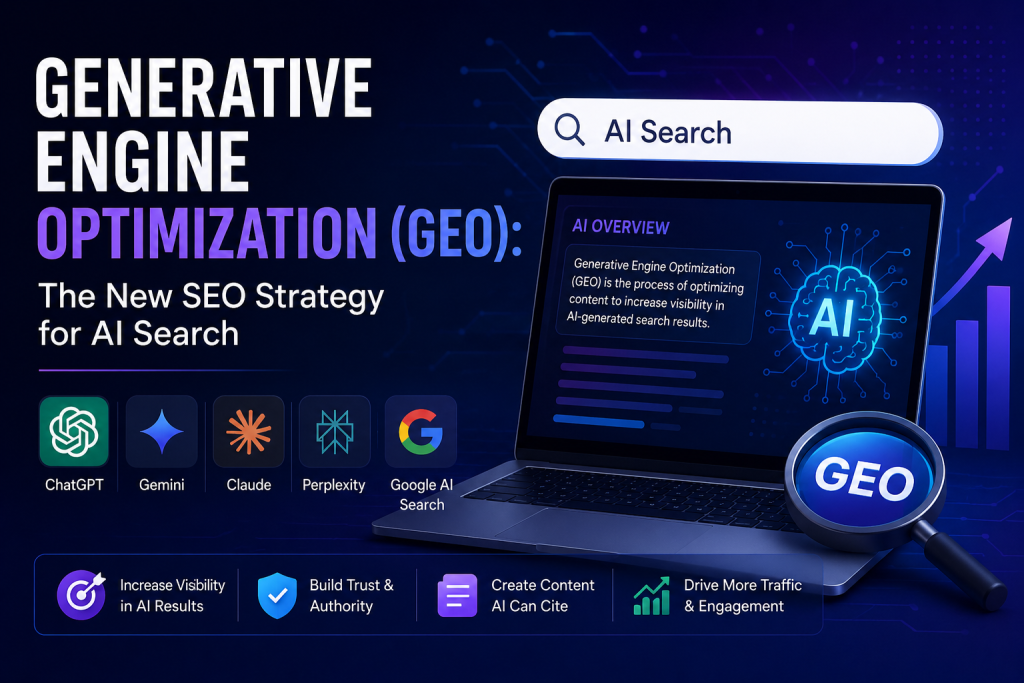
Generative Engine Optimization (GEO) is transforming the future of search as AI-powered platforms continue to change how users discover information online.
For more than two decades, businesses have relied on Search Engine Optimization (SEO) to improve rankings, increase organic traffic, and generate qualified leads from search engines. Traditionally, SEO success was largely determined by factors such as keywords, backlinks, technical optimization, and content quality.
However, the search landscape is changing rapidly.
Today, a new era of search has arrived. Instead of relying solely on traditional search engines, users are increasingly turning to AI-powered platforms such as ChatGPT, Google AI Overviews, Gemini, Claude, and Perplexity. These platforms help users find answers, research products, compare services, and make purchasing decisions more efficiently.
As a result, user behavior is evolving. Rather than browsing through multiple websites, many users now receive direct AI-generated responses that summarize information from various sources.
Consequently, businesses must adapt their digital marketing strategies to remain visible in this new environment.
This shift has led to the emergence of a new discipline known as Generative Engine Optimization (GEO).
Unlike traditional SEO, which focuses primarily on improving rankings in search engine results pages, GEO focuses on optimizing content, websites, and digital authority so that AI search engines can reference, cite, and recommend your brand within their generated responses.
Furthermore, as AI-powered search continues to grow, brands that establish authority early are more likely to be recognized as trusted sources by AI systems.
Ultimately, businesses that embrace GEO today will gain a significant competitive advantage. Not only will they improve their visibility across AI-powered platforms, but they will also position themselves for long-term success in the rapidly evolving future of search.
Why Generative Engine Optimization Is Important
Generative Engine Optimization (GEO) is the process of optimizing digital content to increase visibility within AI-generated search results.
Unlike traditional SEO, which aims to rank webpages on search engine result pages (SERPs), GEO aims to make content discoverable, trustworthy, and useful enough for AI systems to reference when generating answers.
Furthermore, GEO focuses on helping brands become trusted sources within AI-generated responses rather than simply improving rankings in traditional search engines.
Examples of Generative Search Platforms
- ChatGPT
- Google AI Overviews
- Google AI Mode
- Gemini
- Claude
- Perplexity
- Microsoft Copilot
When users ask questions, these platforms analyze vast amounts of information and generate conversational responses instead of displaying only a list of links.
The goal of GEO is to ensure your content becomes part of those answers.
Why Generative Engine Optimization (GEO) Matters More Than Ever
AI search adoption is growing rapidly. In fact, millions of users now ask AI assistants questions such as:
- What are the best SEO services for small businesses?
- Which CRM software should I choose?
- How can I improve website conversions?
- What is the best digital marketing strategy for startups?
Instead of clicking through ten websites, users often receive comprehensive AI-generated summaries.
As a result, visibility is no longer limited to Google’s first page.
Therefore, brands must now compete for inclusion within AI-generated responses.
Furthermore, organizations that fail to adapt may experience reduced organic visibility as users increasingly rely on AI-generated answers.
Ultimately, businesses that embrace Generative Engine Optimization (GEO) early will be better positioned to maintain visibility and authority in the evolving AI search landscape.
GEO vs Traditional SEO
Although GEO and SEO share similar foundations, their objectives differ.
Traditional SEO Focuses On
- Search engine rankings
- Organic traffic
- Keywords
- Backlinks
- SERP visibility
- Click-through rates
GEO Focuses On
- AI citations
- AI recommendations
- Knowledge authority
- Entity recognition
- Trustworthiness
- Contextual relevance
SEO helps people find your website through traditional search engines.
In contrast, GEO helps AI systems understand, trust, and recommend your content within AI-generated responses.
Therefore, businesses should not view SEO and GEO as competing strategies. Instead, they should use both approaches together to maximize online visibility.
Ultimately, the most successful digital strategies in 2026 will combine both SEO and GEO to reach users across traditional search engines and AI-powered search platforms.
How AI Search Engines Select Sources
Many businesses assume AI simply pulls information from top-ranking pages.
In reality, modern AI systems evaluate multiple signals when generating responses.
Content Quality
AI models prefer content that provides clear, comprehensive, and accurate information.
Topical Authority
Websites that consistently publish expert-level content on a specific subject are more likely to be referenced.
Entity Recognition
AI increasingly understands brands, organizations, people, products, and concepts as entities rather than simple keywords.
Trust Signals
Factors such as citations, expert authorship, reviews, references, and domain authority contribute to credibility.
Structured Information
Well-organized content helps AI systems understand context and extract useful information more effectively.
Furthermore, structured information provides additional clarity, making it easier for AI systems to identify key topics and relationships within your content.
As a result, search engines and AI platforms can better interpret the meaning of your content and determine its relevance to specific queries.
Therefore, the more trustworthy and authoritative your content appears, the greater your chances of being referenced by AI search engines and included in AI-generated responses.
The Core Principles of GEO
1. Generative Engine Optimization Topic Authority
Publishing isolated articles is no longer enough.
Instead, businesses should focus on building comprehensive content around a specific topic or industry.
As AI search continues to evolve, AI systems increasingly favor websites that demonstrate deep expertise across an entire subject area.
Furthermore, creating multiple high-quality pieces of content around related topics helps establish authority and strengthen credibility.
As a result, businesses can improve their chances of being recognized and referenced by AI-powered search platforms.
2. Generative Engine Optimization and Entity Optimization
Traditional SEO often emphasizes keyword density and exact-match phrases.
AI search systems increasingly focus on entities and relationships.
3. Generative Engine Optimization Trust Signals
Trust is becoming one of the most important ranking factors in AI search.
Businesses should strengthen:
- Author profiles
- Case studies
- Testimonials
- Reviews
- Industry citations
- Original research
4. Generative Engine Optimization Content Strategy
Generative search thrives on question-based content.
Businesses should create content that directly answers real user questions.
Content Strategies for Generative Engine Optimization (GEO)
Content remains the foundation of Generative Engine Optimization.
Long-Form Educational Content
Comprehensive guides provide more context and authority than short articles.
Examples include:
- Ultimate guides
- Industry reports
- Case studies
- Research-based articles
Original Insights
AI systems value unique information.
Original research, surveys, data studies, and expert analysis help differentiate your content from competitors.
FAQ Sections
Frequently Asked Questions align naturally with how users interact with AI systems.
Expert Commentary
Including expert opinions and practical experience strengthens credibility.
The Role of Structured Data in GEO
Structured data helps search engines and AI systems understand content more effectively.
Recommended Schema Types
- Organization Schema
- Article Schema
- FAQ Schema
- Product Schema
- Review Schema
- Local Business Schema
Structured data provides additional context that can improve visibility across both traditional and AI search environments.
Measuring Generative Engine Optimization (GEO) Success
Unlike traditional SEO, GEO success cannot be measured solely through rankings.
Important Generative Engine Optimization (GEO) Metrics
Brand Mentions
Furthermore, track how often your brand appears across AI-generated responses.
Referral Traffic
In addition, monitor visits originating from AI-powered search platforms.
Authority Growth
Measure backlinks, citations, and industry recognition.
Organic Visibility
Evaluate performance across both traditional search and AI search.
Engagement Metrics
Track user behavior after visitors arrive on your website.
Common Generative Engine Optimization (GEO) Mistakes
Overusing AI-Generated Content
Publishing large volumes of low-quality AI content can damage authority.
Ignoring Brand Authority
Strong brands are more likely to be referenced than anonymous websites.
Focusing Only on Keywords
AI search relies heavily on context and entities rather than exact keyword matches.
Publishing Generic Content
AI systems prioritize unique value over recycled information.
The Future of Generative Engine Optimization (GEO)
Several trends are becoming increasingly clear:
- AI search usage will continue to increase.
- Traditional search behavior will evolve.
- Brand authority will become increasingly important.
- Entity-based optimization will grow.
- AI citations may become as valuable as search rankings.
- Trust and expertise will play a larger role in visibility.
Businesses that invest in GEO today can establish authority before competition intensifies.
In addition, businesses looking to leverage artificial intelligence beyond search optimization can explore our comprehensive guide to AI in Digital Marketing.
Conclusion
Generative Engine Optimization (GEO) represents the next evolution of digital visibility.
As AI-powered search platforms such as ChatGPT, Gemini, Claude, Perplexity, and Google AI Overviews continue to reshape how users discover information, businesses must adapt their digital marketing strategies accordingly. In fact, AI search is changing not only how people find information but also how brands gain online visibility.
While traditional SEO remains an essential part of digital marketing, it is no longer sufficient on its own. Today, businesses need a broader approach that considers both traditional search engines and AI-powered search platforms.
Therefore, success in the AI search era depends on several key factors, including authority, trust, expertise, entity optimization, and high-quality content that answers real user questions. Moreover, businesses must focus on creating valuable, accurate, and well-structured content that AI systems can easily understand and reference.
As AI-generated search results become more common, organizations that embrace GEO early will gain a significant advantage. Not only can they increase their chances of earning AI citations, but they can also strengthen brand visibility and build long-term authority within their industry.
Furthermore, businesses that invest in GEO today will be better positioned to remain competitive as search technology continues to evolve. As a result, they can reach new audiences through both traditional search results and AI-generated recommendations.
Ultimately, the future of search is not just about ranking on Google. Instead, it is about becoming a trusted and authoritative source that AI platforms recognize, reference, and recommend to users. By combining traditional SEO with a strong GEO strategy, businesses can improve their visibility, enhance their credibility, and prepare for the next generation of search.
Frequently Asked Questions (FAQ)
Generative Engine Optimization (GEO): What Is It and Why Does It Matter?
GEO is the practice of optimizing content so that AI-powered search engines and assistants can discover, trust, and reference your information in generated responses.
Is GEO replacing SEO?
No. GEO complements SEO. Businesses should combine both strategies to maximize visibility across traditional and AI search platforms.
Can ChatGPT recommend my website?
Yes. If your website demonstrates expertise, authority, trustworthiness, and publishes high-quality content, it has a better chance of being referenced by AI systems.
Why is GEO important in 2026?
As AI search becomes more popular, businesses need strategies that help them appear in AI-generated answers, not just traditional search results.
To learn more about AI-powered search, visit Google Search Central.