
Mushroom coffee has jumped from niche health stores into ordinary supermarket aisles. Shoppers now spot it sitting beside single-origin beans and premium decaf. Naturally, that raises a fair question. Does it deserve the attention, or is it clever marketing in a nice pouch?
This guide explains what the drink is, how it tastes, and what the research genuinely supports. Along the way, we look at the wider functional coffee movement that is reshaping the whole category. By the end, you should know whether a switch suits your routine or not.
Before we dive in, one point is worth setting straight. Mushroom coffee is not a health cure, and no serious brand claims otherwise. Rather, it is a gentler version of a drink most of us already love. Keep that framing in mind and the rest of this article makes far more sense.
What Is Mushroom Coffee, Exactly?
Mushroom coffee is a blend of ground coffee beans and extracts from functional mushrooms. Producers do not use the button mushrooms from your fridge. Instead, they choose species such as lion’s mane, chaga, reishi and cordyceps.
The production process is fairly simple. First, growers harvest the fruiting bodies of each species. Next, a dual extraction step pulls out both water-soluble and alcohol-soluble compounds. Finally, the extract is dried and milled into a fine powder.
That powder then goes into roasted coffee, often at roughly a one-to-one ratio. Because the mushroom portion carries no caffeine of its own, the finished cup lands lighter than a standard brew. You can buy mushroom coffee as instant sachets, ground blends, capsules and ready-to-drink cans.
Most drinkers describe the flavour as dark, smooth and slightly nutty. Some blends taste faintly earthy. Others hide the fungal notes almost completely behind a medium or dark roast.
Why Functional Coffee Is Booming Right Now
Functional coffee is the umbrella term for any brew designed to deliver something beyond caffeine. Protein coffee, collagen coffee, nootropic blends and mushroom coffee all sit inside that group. Clearly, the category has real momentum behind it.
The market numbers back that up. Analysts valued the global category at roughly USD 3.23 billion in 2025, with forecasts pointing towards USD 5.56 billion by 2035. That works out to a compound annual growth rate near 5.6 percent. North America holds about 29 percent of revenue, while Europe is growing fastest at around 6.6 percent a year.
Several forces explain the surge. Firstly, younger drinkers want less caffeine without giving up the ritual of a warm cup. Secondly, curiosity about adaptogens, gut health and clean labels keeps climbing. Thirdly, social media turned the drink into a visible lifestyle choice rather than a dusty supplement.
Retail habits shifted too. Supermarkets and hypermarkets now account for roughly 47 percent of sales, so shoppers no longer need a specialist store. Meanwhile, online channels keep expanding at about 6.3 percent a year. Powdered formats dominate as well, taking close to 64 percent of the market.
Meet the Four Mushrooms Inside Your Cup
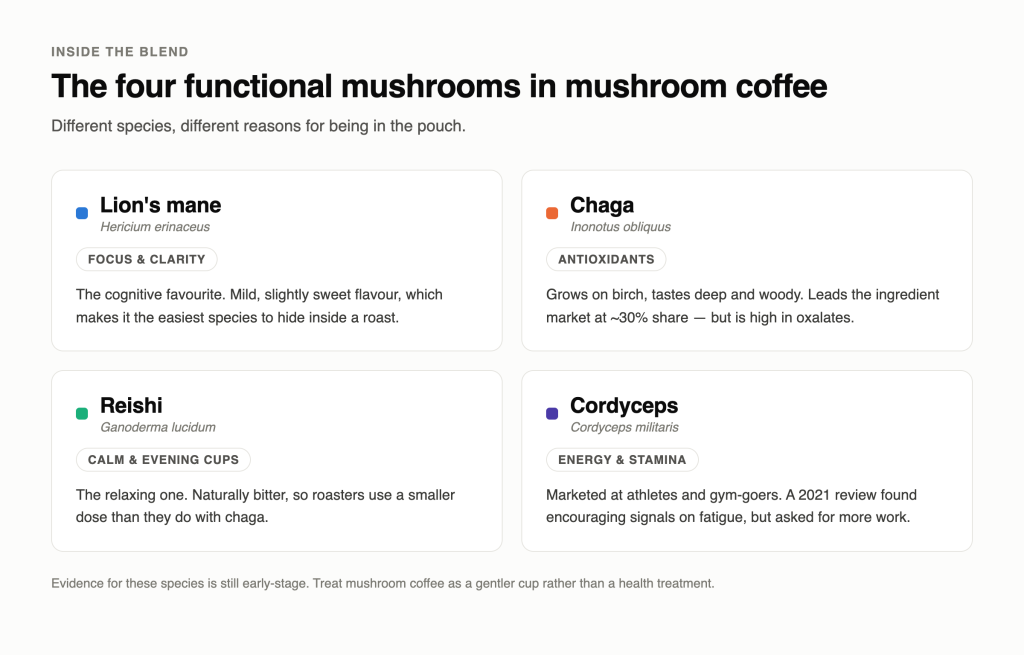
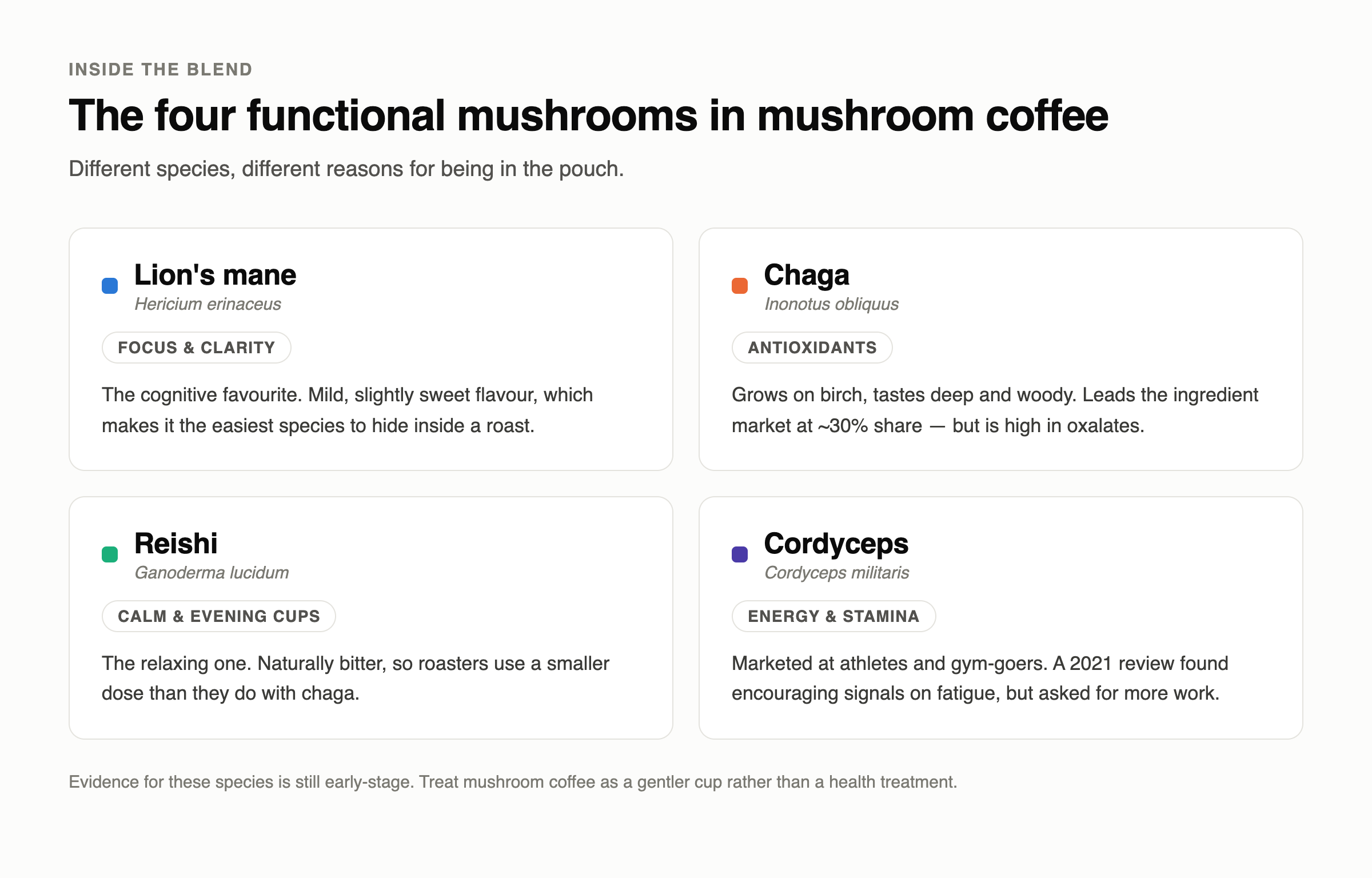
Not every blend uses the same species. Therefore, reading the label matters more than you might expect. Here are the four you will meet most often.
Lion’s Mane
Lion’s mane is the cognitive favourite. Brands link it to focus, memory and mental clarity. Because of that reputation, it appears in almost every “morning focus” blend on the shelf. Its flavour is mild and slightly sweet, which makes it the easiest species to hide inside a roast.
Chaga
Chaga grows on birch trees and carries a deep, woody flavour. It leads the ingredient market with roughly 30 percent of revenue share. Reviews point to antioxidant and anti-inflammatory activity, though the evidence is still early. Notably, chaga also carries the clearest safety caveat of the four, which we cover further down.
Reishi
Reishi is the calming one. Producers usually place it in evening or low-caffeine blends. Its taste runs bitter, so roasters tend to use a smaller dose than they do with chaga. If you want a cup after dinner, a reishi-forward blend is generally the better pick.
Cordyceps
Cordyceps is marketed towards energy and stamina. A 2021 review in Frontiers in Pharmacology looked at its effect on fatigue and found encouraging signals. Even so, the authors asked for more work on the active compounds involved. Athletes and gym-goers tend to gravitate towards this one, especially in pre-workout mushroom coffee blends.
Mushroom Coffee Benefits: What the Science Actually Says
This is where honesty matters. Marketing claims run far ahead of the published evidence, so it helps to separate the two.
Some human research does exist. A 2023 study of 41 healthy adults aged 18 to 45 found that participants completed a cognitive task faster after a single dose of lion’s mane. After 28 days, the same group reported lower stress, although that difference was not statistically significant. Separately, a 2024 analysis suggested improvements in cognition and energy among older adults.
Reviews of chaga point to immune-supportive and anti-inflammatory effects. However, most of that work happens in laboratories or animal models rather than in people. Consequently, nobody can promise you a specific outcome from one cup.
The most defensible mushroom coffee benefits are therefore modest but real:
- Roughly half the caffeine of a normal cup, which suits sensitive drinkers.
- Fewer jitters and a gentler comedown for many people.
- Extra antioxidants from both the beans and the extracts.
- A lower-acid brew that some stomachs tolerate better.
- Early but promising evidence around focus and fatigue.
One more point deserves attention. Coffee itself already carries a solid body of research behind it, covering everything from liver health to alertness. Therefore, part of what you feel in the cup simply comes from the beans. The extracts sit on top of that base rather than replacing it.
In short, treat mushroom coffee as a pleasant swap rather than medicine. That expectation keeps disappointment away.
Mushroom Coffee vs Regular and Decaf Coffee
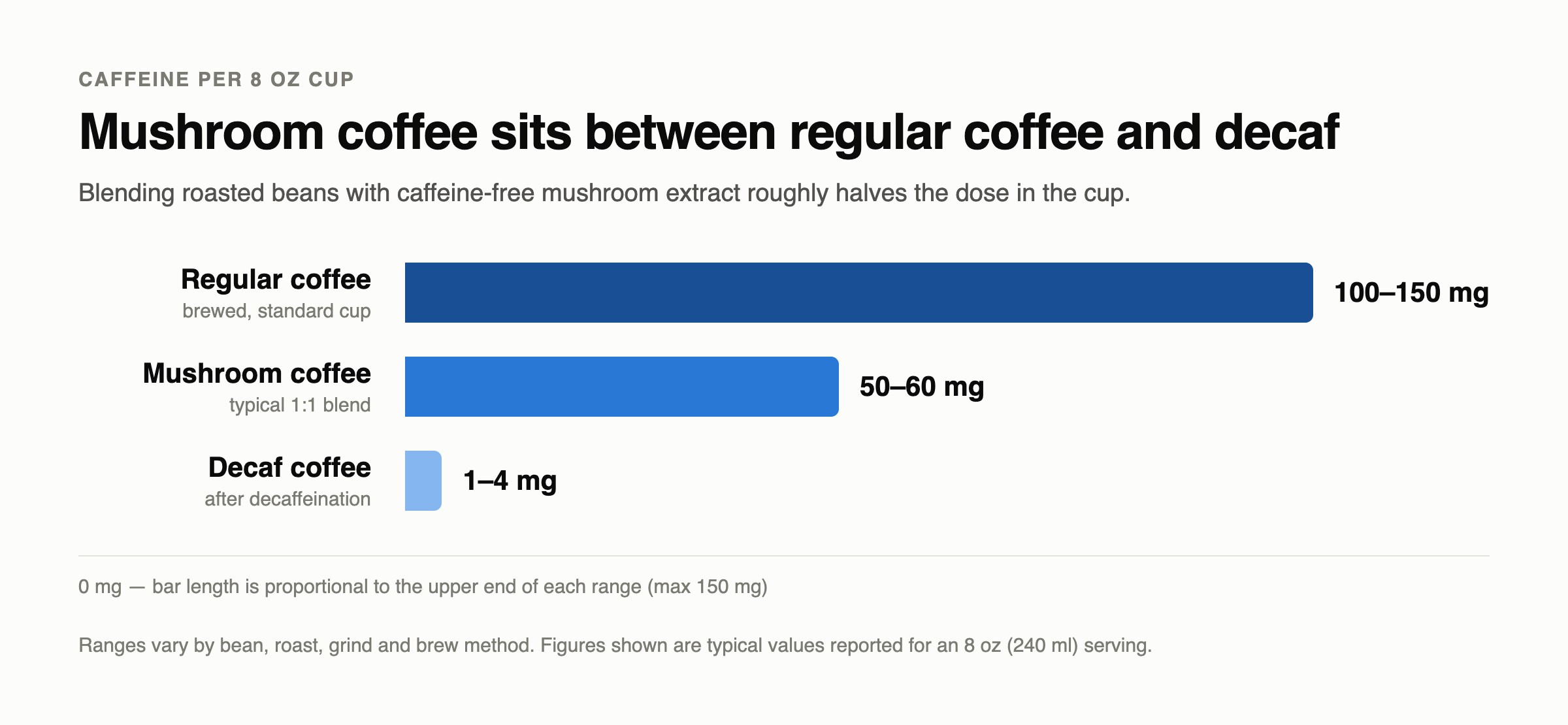
Caffeine is the clearest difference between the three options. A standard cup of brewed coffee delivers roughly 100 to 150 mg. A typical mushroom blend gives about 50 to 60 mg, because the powder dilutes the beans. Decaf, by contrast, sits far lower at around 1 to 4 mg.
That middle position explains the appeal. Decaf removes the lift almost entirely, while a double espresso can leave sensitive drinkers wired until midnight. Mushroom coffee lands neatly between them.
Price is the other honest comparison. Functional blends usually cost around double the price of ordinary supermarket coffee. Sourcing explains much of that gap, since these species are harder to farm at scale than arabica beans.
Flavour sits somewhere in the middle as well. A good blend tastes like a slightly softer dark roast. A cheap one can taste flat or oddly savoury, so quality really does show up in the cup.
How to Brew Mushroom Coffee That Tastes Good
Brewing method changes the result more than most people assume. Fortunately, the fixes are easy.
- Use water at about 90 to 94 degrees Celsius. Boiling water scorches the extract and sharpens any bitterness.
- Stir instant blends thoroughly, then let the cup rest for thirty seconds so the powder fully dissolves.
- Choose a French press or pour-over for ground blends. Both handle the finer particles well.
- Add a splash of oat milk if earthiness bothers you. Fat rounds off the flavour nicely.
- Try a pinch of cinnamon or cocoa instead of sugar. Both complement the nutty base.
Storage matters as well. Keep the pouch sealed, cool and away from sunlight. Otherwise the powder clumps and the aroma fades within weeks.
Who Should Be Careful With Mushroom Coffee
Most healthy adults tolerate these blends without trouble. Still, a few groups should pause before switching.
Chaga contains high levels of oxalates. For that reason, anyone with kidney disease or a history of kidney stones should avoid it. Long-term safety data across all four species remains thin, and interactions with medication are not well mapped.
Pregnant and breastfeeding women should also check with a doctor first. The same applies to people on blood thinners, immunosuppressants or diabetes medication. Health authorities generally advise a conversation with your clinician before starting any complementary product.
Mushroom allergies are rare but real. Therefore, start with half a serving and watch how you feel. If you notice digestive upset, headaches or skin reactions, simply stop and speak to a professional. Sensible caution costs nothing, and it applies to plenty of everyday wellness habits, from supplements to natural home remedies for common ailments.
This article shares general information only. It is not medical advice, so please treat it that way.
What to Expect During Your First Two Weeks
Expectations shape the experience, so it helps to know the usual pattern. Most people notice the change in caffeine before anything else.
Days one to three often feel flat. Your body is used to a bigger hit, and roughly half the dose can register as a mild slump. Some drinkers get a light headache around the afternoon. Consequently, many experts suggest tapering rather than switching overnight.
Days four to seven usually settle down. Energy tends to feel steadier through the morning, with less of the sharp crash around two o’clock. Sleep quality improves for some people, particularly those who used to drink coffee late.
By the second week, taste preference takes over. Either you enjoy the softer, nuttier cup or you do not. Both answers are perfectly valid. A simple trick helps here: blend your mushroom coffee half and half with your usual grounds for the first week, then shift the ratio gradually.
Keep a short note on your phone during the trial. Track sleep, focus and any digestive changes. That way, you judge the swap on evidence rather than on mood alone.
How to Choose a Quality Functional Coffee Blend
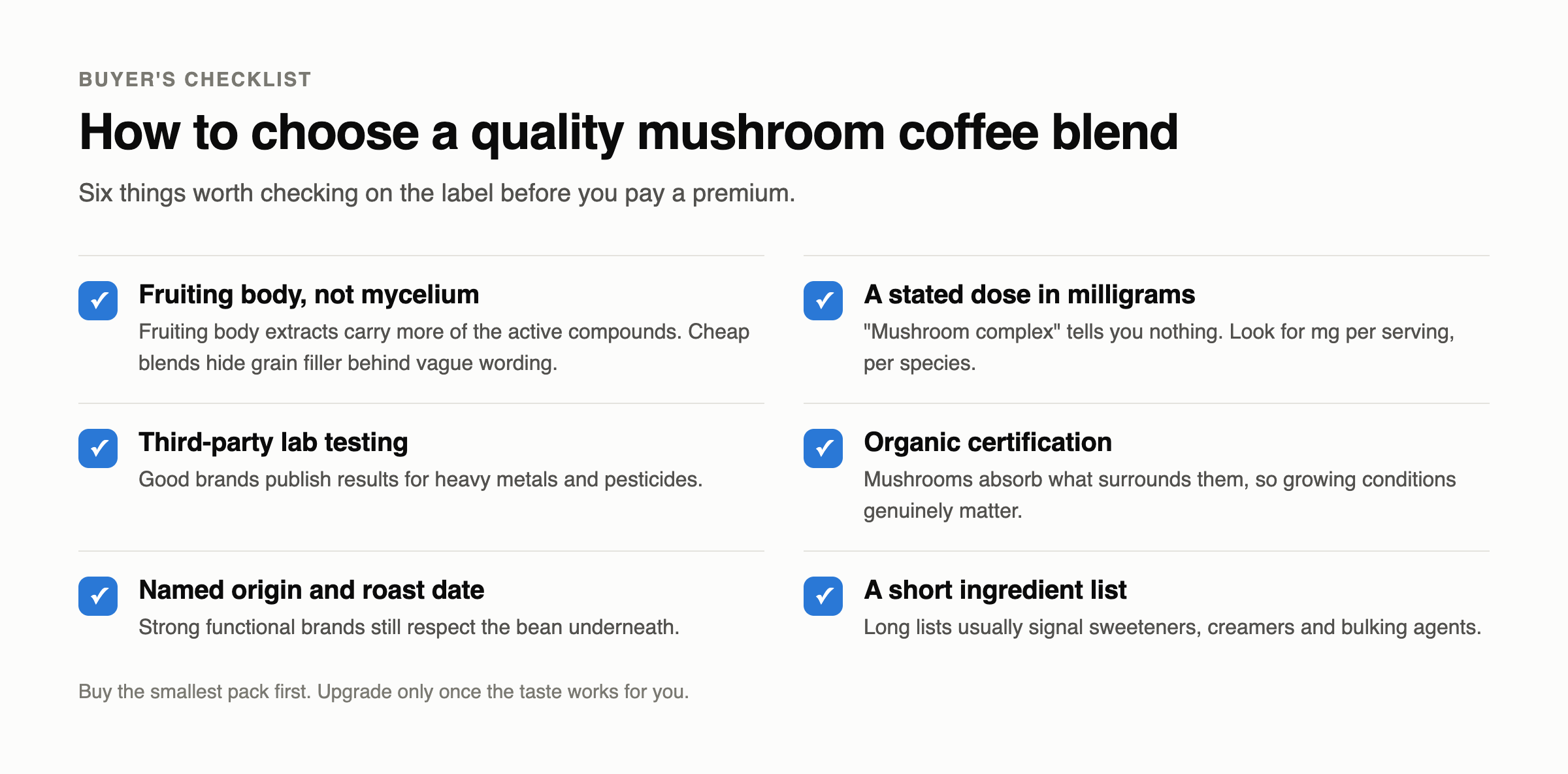
Labels vary wildly across the shelf. Quality ranges from carefully extracted, lab-tested products to little more than flavoured filler. Consequently, a short checklist saves both money and disappointment when you buy mushroom coffee for the first time.
- Fruiting body, not mycelium on grain. Fruiting body extracts carry more of the active compounds. Cheap products often hide grain filler behind vague wording.
- A stated dose in milligrams. Vague phrases like “mushroom complex” tell you nothing useful.
- Third-party lab testing. Good brands publish results for heavy metals and pesticides.
- Organic certification. Mushrooms absorb what surrounds them, so growing conditions genuinely matter.
- Named coffee origin and roast date. Strong functional brands still respect the bean.
- A short ingredient list. Long lists usually signal sweeteners, creamers and bulking agents.
Watch the caffeine claim as well. Some blends cut the coffee content heavily, while others barely dilute it at all. Since the whole appeal often rests on that gentler lift, the milligram figure belongs on the label.
Buy the smallest pack first. If the taste works for you, then upgrade to a larger pouch or a subscription.
Common Questions About Functional Coffee
Does mushroom coffee taste like mushrooms?
Rarely, and only faintly. A decent blend tastes like a smooth, nutty dark roast. Reishi-heavy products lean slightly bitter, so start elsewhere if bitterness bothers you.
Is mushroom coffee good for caffeine-sensitive drinkers?
Usually, yes. Half the caffeine means half the jitters for many people. Nevertheless, decaf remains the better route if you need to cut caffeine almost completely.
Can I drink mushroom coffee every day?
Most people do exactly that without any issue. However, long-term studies are limited. One or two cups a day is a sensible ceiling until better data arrives.
Is mushroom coffee the same as instant coffee?
No, although many blends arrive in instant form for convenience. The difference lies in the added extracts, not the format itself. Ground and whole-bean versions exist too.
Will it break a fast?
A plain black cup contains very few calories, so it generally will not. Sweetened or creamer-based sachets are a different story, though. Always check the nutrition panel.
Is Mushroom Coffee Worth It?
For the right drinker, absolutely. If caffeine leaves you anxious, or if you simply enjoy trying premium and organic products, mushroom coffee is an easy experiment. It costs more than a standard bag, yet the smoother lift wins plenty of people over.
For everyone else, the honest verdict is softer. The research on functional mushrooms looks promising rather than proven. Nobody should expect sharper thinking or a stronger immune system from a single cup.
Above all, judge it as coffee first. Buy a quality blend, brew it properly, and enjoy the ritual. If the extracts help as well, treat that as a welcome bonus rather than the whole point.
Further reading: see Healthline’s evidence review of mushroom coffee and the Precedence Research market forecast.